

Get more leads, book more showings, and grow your commission income with a real estate website built to convert.





When a buyer relocates to a new city or a homeowner decides it's time to sell, they don't pull out the phone book. They grab their phone and search for "real estate agent near me" or "best realtor in [their city]." Within seconds, they're scanning websites, evaluating agents, checking listings, and deciding who deserves a callback.
If your real estate business doesn't have a professional website—or has one that looks outdated, slow, or generic—you're losing those potential clients to agents who made the investment in their digital presence.
This article breaks down why a professional website is essential for real estate agents and brokerages, what makes one effective, and how to build one that generates more leads, more showings, and more closed deals.
Want a website that brings in buyers and sellers while you're focused on closing? Book a free strategy call with ESPLocal to see how we can build a high-converting website for your real estate business—designed before you pay a dime.
See your finished website before you pay a dime. We design it first, you review and approve, then we deploy in 2–3 days.
A professional website is your most powerful sales tool, working 24/7 to attract buyers and sellers, build trust, and drive commission revenue. Here's what a premium, well-built website does for your real estate business:
Real estate decisions don’t happen 9-to-5. A couple decides to start looking on a Sunday evening. A relocation package comes through and someone has 48 hours to find an agent in a new city. A homeowner wakes up and decides today is the day to list. These moments happen at all hours, and they all start with a Google search.
Without a professional, SEO-optimized website, you’re invisible in those moments. With one, you appear right when buyers and sellers are motivated and actively looking for representation.
Buyers and sellers are making one of the biggest financial decisions of their lives. They research agents carefully before reaching out—and the first thing they check is your website. A professional site with a strong bio, transaction history, client testimonials, and local market knowledge tells them: this agent knows what they’re doing and is worth my time.
A generic template site, a LinkedIn page, or a Zillow profile alone doesn’t build the same confidence as a purpose-built professional website that speaks directly to your market and specialty.
A professional real estate website captures buyer and seller leads 24/7 through home valuation tools, neighborhood search forms, listing inquiry buttons, and contact forms. While you’re at a showing, on the phone, or off on the weekend, your website is working to fill your pipeline.
Every page is an opportunity to capture a lead from someone who isn’t ready to call yet but is close to making a decision.
Zillow, Realtor.com, and Redfin are powerful platforms—but you don’t control your presence on them. Your listings appear alongside every other agent in your market. Your competitors advertise next to your properties. And the platform owns the relationship with the buyer or seller, not you.
Your website is the one place where you control your brand completely: your specialty, your personality, your track record, your market knowledge. No competitor shares that page with you.
A solo agent or small team with a sharp, professional website can compete directly with a 50-agent brokerage in local search results. SEO, neighborhood expertise, and personal brand storytelling level the playing field in ways that advertising budget alone can’t.
Clients hiring a real estate agent aren’t always looking for the biggest team—they’re looking for the agent who knows their neighborhood, understands their situation, and makes them feel like a priority. Your website is where that impression is made.
Buyers want to work with someone who knows the market, not just has access to the MLS. A website with neighborhood guides, market reports, school district information, and local lifestyle content demonstrates expertise before you’ve ever spoken to a client.
This content also ranks in search engines—so buyers searching “best neighborhoods in [city]” or “schools near [neighborhood]” find you before they ever look for an agent directly.
Real estate agent advertising—postcards, bus benches, print ads, sponsored Zillow listings—requires constant spending to maintain visibility. A professional website, once built and optimized, generates organic traffic from buyers and sellers searching your market month after month without ongoing per-impression costs.
Your website is the marketing investment that pays dividends long after the initial build, compounding value as your content library grows and your search authority increases.
Building a real estate website that actually generates business requires more than picking a template and uploading your headshot. You need a site that's fast, mobile-friendly, optimized for local search, and designed to convert visitors into clients.
Here's what to focus on:
Real estate searches happen on phones—while driving through neighborhoods, at open houses, after dinner when the listing search starts. A website that loads slowly or doesn’t display listings correctly on a small screen loses buyers and sellers immediately to agents whose sites do.
Every page should load in under 3 seconds. Listing photos should display beautifully on mobile. Contact forms should be effortless on a small screen. Mobile optimization is non-negotiable in a business where clients are always searching on their devices.
Real estate clients search locally: “homes for sale in [neighborhood],” “real estate agent in [city],” “condos near [landmark].” Your website needs to rank for these searches with dedicated neighborhood pages, market report content, and location-specific keywords throughout every page.
Build location pages for every neighborhood, suburb, and community you serve. Include local market data, school information, lifestyle content, and links to available listings. A real estate website without local content is invisible in the searches buyers and sellers actually use.
The best real estate websites don’t wait for a visitor to decide to reach out—they create multiple opportunities for leads to raise their hand at different stages of the decision process. A home valuation tool captures sellers early. A listing search form captures buyers researching. A newsletter signup captures people who aren’t ready yet but will be.
Place lead capture opportunities naturally throughout the site—not just on the contact page. Convert visitors at whatever stage they’re in, not just the moment they’re ready to commit.
In real estate, clients are choosing a person as much as a service. Your about page, your listing history, your client testimonials, and your bio aren’t supporting content—they’re central to the decision. Feature your transaction volume, your market specialization, your years of experience, and specific client stories prominently throughout the site.
Specificity builds trust. “I’ve closed 47 transactions in the Midtown corridor over the past 3 years” is more convincing than any generic claim about “dedicated service” or “market expertise.”
Your website should match the level of service you deliver to clients. If you’re a luxury agent who provides white-glove service, concierge-level guidance, and elevated marketing for listings—your website should communicate that before a seller ever requests a listing presentation.
Use professional photography, a polished design, and copy that speaks directly to your target client. Generic agent templates built on brokerage platforms never communicate what makes an individual agent worth hiring over every other option in the market.
At ESPLocal, we’ve built websites for real estate agents and brokerages across the country, and we know exactly what drives results in this industry.
Our approach is different from most agencies. We design your website before requesting payment. You review it, we refine it, and upon approval, we deploy within 2–3 days. No surprises, no guesswork, no months of back-and-forth while your pipeline sits cold.
Here’s what you get with an ESPLocal real estate website:
Mobile-first and high-performance. Every site is built for speed and optimized for the devices buyers and sellers use to search listings and find agents.
Structured for local SEO. We build your site from the ground up to rank in your market with proper schema, neighborhood pages, and location-based keyword targeting baked in.
Conversion-focused by design. Home valuation tools, listing search, lead capture forms, and strategic CTAs placed exactly where buyers and sellers are ready to engage.
Built to reflect your real-world quality. We don’t use generic agent templates. Your site is designed to showcase your personality, your track record, and what makes you the right agent for your market.
With 42+ years of cumulative experience building websites for service businesses, we know what works and what doesn’t.
Schedule a free strategy call to see how we can build a website that generates more leads and closes more deals for your real estate business.
Looking at real-world examples is one of the fastest ways to understand what makes a real estate website effective. These five sites demonstrate the design principles, trust elements, and conversion strategies that drive results.
Ryan Serhant's website is as bold as his personal brand. The homepage opens with full-screen video of luxury properties and a personal message from Serhant himself—immediately establishing that this isn't a generic brokerage site, it's the digital headquarters of one of the most recognizable names in real estate.
The site features his listings front and center, a clear pathway to connect with his team, and content that reinforces his positioning as a media presence, author, and market authority—not just an agent. Every element is designed to communicate that working with Serhant means access to reach and relationships that no typical agent can offer.
Why this works: Ryan Serhant built a personal brand first and used his website to extend it. His digital presence communicates scale, ambition, and results before a potential client ever reads his bio. For buyers and sellers at the top of the market, that positioning alone justifies the call.

The Agency's website is one of the most visually sophisticated in the real estate industry. The homepage leads with stunning property photography and a brand identity that feels more like a luxury lifestyle publication than a brokerage site.
The site features global listings, agent profiles, and market-specific content across every market they operate in. The design is dark, editorial, and aspirational—communicating that The Agency operates in a different tier than conventional brokerages. Their technology platform and tools are prominently featured, appealing to agents and buyers who expect a modern, tech-forward experience.
Why this works: The Agency understood that in luxury real estate, brand perception is half the product. By investing in world-class design and editorial photography, they signal to buyers and sellers that their properties will be presented at the highest possible level. The website itself is proof of that commitment.

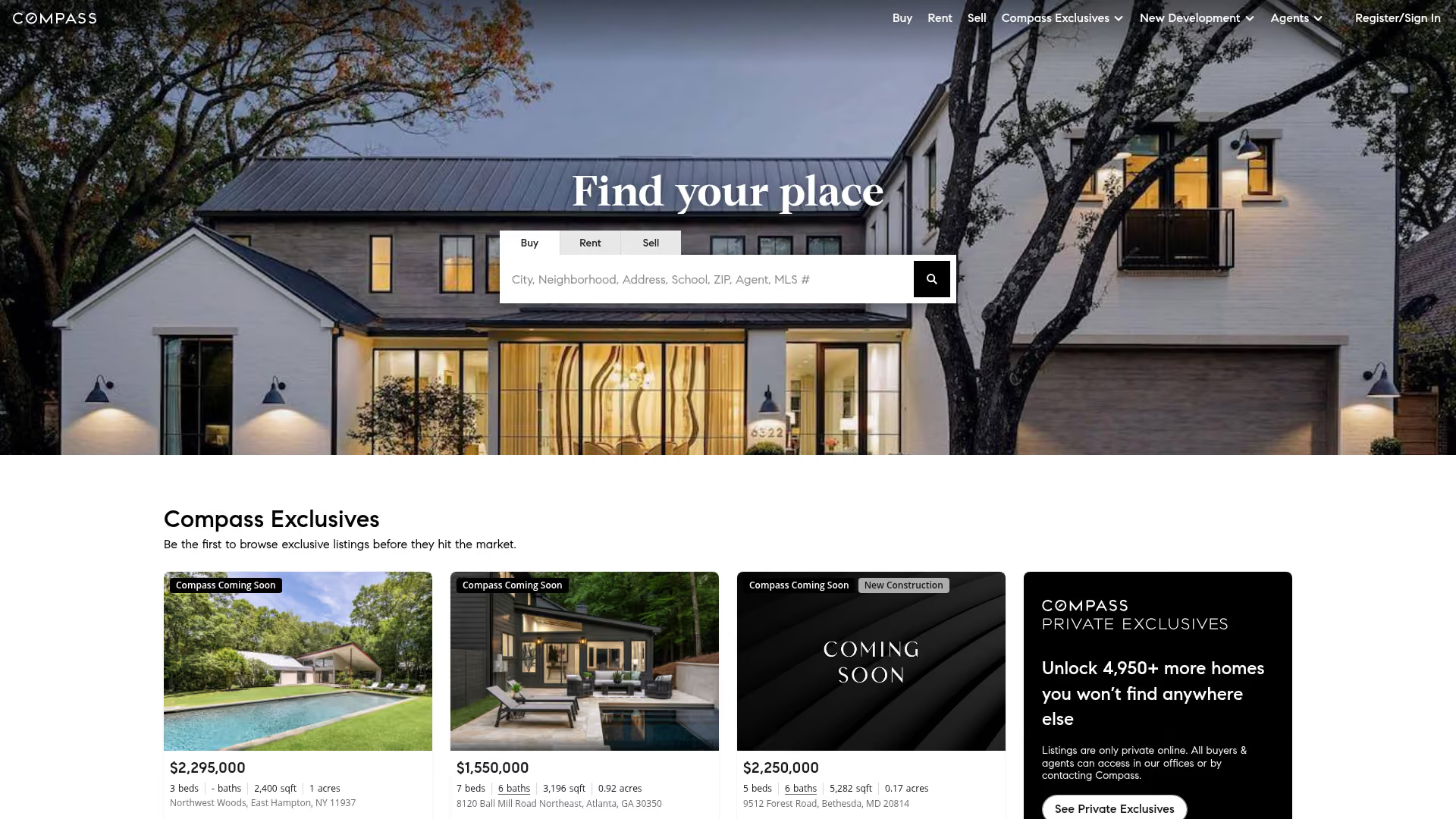
Compass built one of the most technically sophisticated real estate platforms in the industry. The website leads with a clean search experience, allowing buyers to search by neighborhood, price, property type, and lifestyle amenities—with filters more granular than most MLS-integrated sites offer.
Agent profiles are prominent throughout, with detailed transaction histories and local market expertise featured for each agent. The site is fast, intuitive, and mobile-optimized, designed for the way buyers actually search for homes today. Compass's technology platform is woven throughout the site as a selling point for agents considering joining the brokerage.
Why this works: Compass treated technology as a competitive differentiator from day one. Their website doesn't just list properties—it provides a search experience that's genuinely better than alternatives, which builds loyalty among buyers and drives agent recruitment by demonstrating the tools they'll have access to.
Tracy Tutor's website is built around personal brand authority in the luxury LA market. The homepage establishes her track record immediately: hundreds of millions in closed transactions, decades in the industry, and a presence on Million Dollar Listing LA that gives her reach most agents never achieve.
The site features her current and past listings, client testimonials from recognizable clients, and a personal bio that builds the kind of trust that drives referrals. Every element is designed to communicate that she's not just an agent—she's the agent for serious buyers and sellers in her market.
Why this works: Tracy Tutor's website works because it leads with proof. The transaction volume, the recognizable clients, the media presence—these aren't vanity metrics, they're evidence that she delivers results at a level most agents don't approach. For buyers and sellers at the top of the LA market, that proof is the deciding factor.

Aaron Kirman's website opens with a cinematic feel—full-screen imagery of the ultra-luxury properties he represents, a quiet confidence that needs no hard sell. His track record speaks for itself: billions in sales, a client roster that includes celebrities and executives, and a presence in the highest tier of the LA luxury market.
The site features his listings prominently, with detailed property pages that treat each home like a feature editorial spread. His team is showcased, his media presence is referenced, and the booking path is elegant and straightforward. Every design decision reinforces the brand promise: this is the agent for properties that deserve the best representation available.
Why this works: Aaron Kirman's website works because it matches the caliber of his listings. A buyer looking at a $20M home expects the agent's digital presence to feel as premium as the property itself. His site delivers that match between expectation and presentation, which creates confidence before a single conversation happens.
See your finished website before you pay a dime. We design it first, you review and approve, then we deploy in 2–3 days.
Costs vary depending on complexity and features. Brokerage-provided template pages are often free but offer almost no customization or SEO value. Dedicated real estate website platforms like Chime or Kvcore run $200–$600/month. Custom-designed real estate websites from agencies typically range from $3,000 to $15,000+. At ESPLocal, we design your website before requesting payment so you can see exactly what you're getting before committing.
Custom-designed real estate websites from agencies typically take 8–16 weeks depending on features like MLS integration and neighborhood content. ESPLocal designs your site upfront and deploys within 2–3 days of approval, giving you a professional, conversion-optimized result without the long wait.
Yes. Your brokerage's website markets the brokerage—not you specifically. Clients searching for an agent don't find you on the brokerage site; they find the brand. Your personal website is where you build your individual reputation, rank for your name and market, and capture leads that go directly to you rather than being distributed across the office. Top-producing agents in every brokerage invest in their own websites.
At minimum, your real estate website needs a homepage, an about page, a listings or property search page, neighborhood guides for every area you serve, a buyer resources page, a seller resources page with home valuation, a testimonials page, and a contact page. Blog or market report content helps with SEO and demonstrates ongoing expertise.
Yes. A real estate website with neighborhood guides, local market content, proper on-page SEO, and schema markup can rank for the local searches buyers and sellers use. "Real estate agent in [city]," "homes for sale in [neighborhood]," and "[city] market update" are all searchable terms you can rank for with the right content. Combined with a strong Google Business Profile, a well-built website significantly increases your local visibility.
The most common mistake is relying on a brokerage template page and treating it as a complete digital presence. These pages look identical to every other agent in the office, rank for nothing, and capture leads for the brokerage rather than for you personally. Top producers invest in their own websites because they understand that their personal brand is their most valuable long-term asset in this business.
ESPLocal has helped 100s of plumbing companies rank higher, generate more qualified leads, and grow revenue through structured, proven local SEO.

Premium websites and structured local SEO for serious brick-and-mortar businesses.
© 2026 ESPLocal. All rights reserved.

